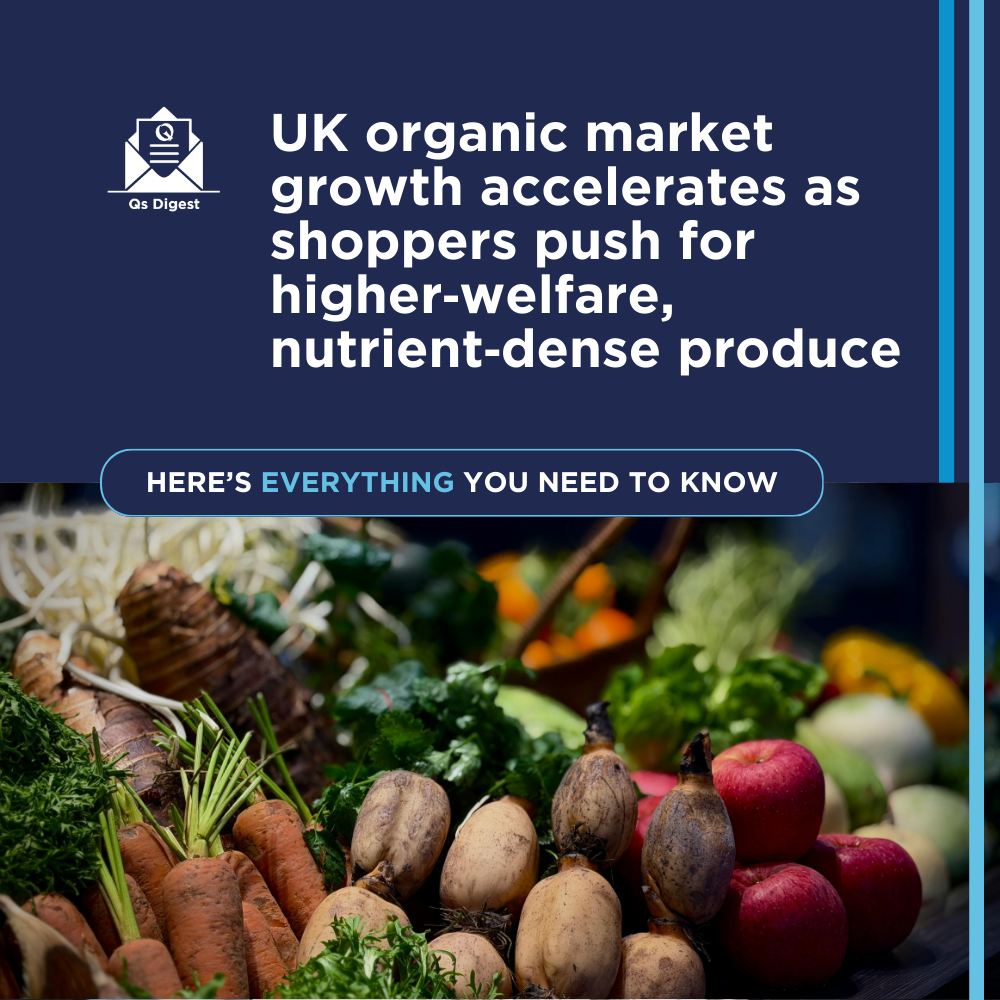
UK organic market growth accelerates as shoppers push for higher‑welfare and nutrient‑dense produce
The UK organic market surged in 2025, driven by increased consumer demand for healthier, higher‑welfare foods, despite limited farmland expansion and ongoing policy challenges.
The UK organic market accelerated sharply last year, with Soil Association Certification’s latest analysis showing organic sales and volumes growing far faster than their conventional counterparts as shoppers shifted towards higher‑welfare and nutrient‑dense produce. According to the certification body’s Organic Market Report, organic sales reached £3.9 billion in 2025, up 4.2% year on year, while organic volume sales rose 1.2% compared with 0.3% for non‑organic items. Industry data also point to dairy and other British staples as important contributors to the uplift.
Retailers were a central force behind the expansion. Soil Association Certification said supermarkets posted a 7% increase in organic sales, with unit growth for organic ranges running roughly four times that of non‑organic lines as grocers broadened ranges, ran promotions and introduced loyalty incentives to capture the trend. Ocado again gained the largest incremental share of organic trade, while M&S, Aldi and Lidl also made notable gains, the report added.
The surge has been reflected across business models beyond the multiples. Independent retailers expanded organic sales by double‑digits in the year to 2025, while specialist box schemes reported stronger demand; Riverford disclosed a 6% sales rise to £117 million in the year to May 2025, underscoring rising consumer appetite for provenance and trust in supply chains. Analysts and trade groups say younger shoppers, including many in Generation Z, are increasingly driving organic purchasing, helping value sales double over the past decade.
Soil Association Certification’s commercial director Alex Cullen attributed the pattern to a growing consumer focus on “healthier, more nature friendly food” and concerns over contaminants and animal welfare; he also warned that changes in eating patterns linked to wider uptake of GLP‑1 medications , with households buying smaller, more nutrient‑dense portions , will likely reinforce demand for organic lines. Cullen added that supermarkets have “taken note of consumer demand for healthy, high‑quality nutrient‑rich food, and have reacted with rebrands and expansions to their organic ranges, along with more price promotions and loyalty discounts”.
Despite the market’s momentum, the expansion of organic farmland in England remains limited, keeping the country reliant on imports for many products. Government figures show organic land remains at roughly 3% of UK farmland, a share the Soil Association says is stagnant and short of the policy backing seen elsewhere. The report noted an increase in land entering conversion in 2025 but said progress slowed sharply after payments under the Sustainable Farming Incentive were frozen.
The certification body pointed to policy action in other parts of the UK and urged ministers in Westminster to set out a funded English Organic Action Plan to give farmers the longer‑term certainty needed to convert at scale. Cullen said the move would help secure a more resilient domestic supply chain, protect biodiversity and support farmers’ livelihoods, arguing that now is the moment for government to match consumer demand with sustained public and private investment.